Felicia
The following takes place following: The Gang Goes To Waitrose
Fiona Malone trudged through the familiar streets of Wexley, her breath visible in the cool October air. The pharmacy bag crinkled in her hand, the weight of her father’s medication pressing against her palm. Each step felt heavier than the last, not just from the physical burden but from the heavy fog of shame clouding her mind.
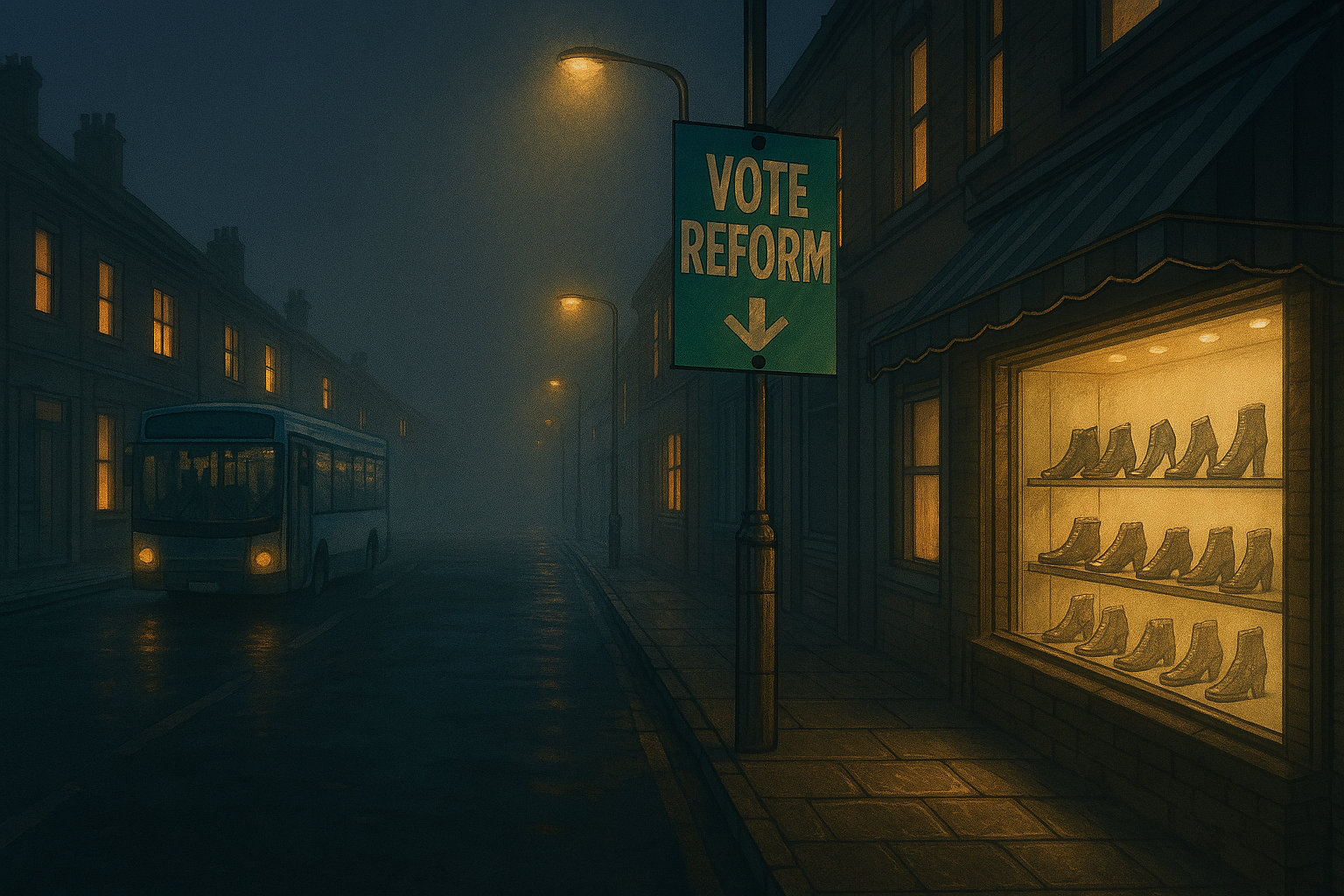
Looking up, she noticed a bright poster on a lamppost: “Don’t Give Up on Reform,” it boldly proclaimed, announcing a by-election for a new candidate. Vote Sarah Whitfield for MP of Wexley. A sharp pang of regret shot through her; she once held that position, a voice for her constituents, but now she was just a shadow of her former self, a deselected MP navigating the fallout of her scandal.
As she passed a shoe shop, something in the window stopped her in her tracks — a gleaming pair of white trainers, the kind her daughter Tina had been pining after for weeks. Fiona had brushed it off then, insisting they couldn’t afford luxuries right now. But seeing them there, spotless under the warm shop lights, something inside her cracked.
She pictured Tina slipping them on, her face bright for the first time in months, walking into school without feeling like the outcast daughter of a disgraced MP. Fiona’s chest tightened. Just this once, she told herself. Just to see her smile.
Moments later she stepped out of the shop, the box tucked carefully under her arm. The shoes were dearer than she’d expected — nearly ninety quid — but the thought of Tina’s excitement made it worth it. For the first time in weeks, she felt something close to hope.
Suddenly, a cold milkshake splashed across her face and chest, soaking the box she clutched. She froze, the laughter of teenagers ringing in her ears.
“Scum!” one of them shouted, and they disappeared down the street, still jeering.
She looked down. The pink liquid had seeped through the thin cardboard, staining it dark. She opened it with trembling hands — the white trainers inside were streaked with milk and syrup, sticky and ruined.
She hurried home, each step quickening as if she could outrun the shame. Fumbling with the keys at her parents’ front door, she finally managed to push it open.
Fiona: “Ma, I’m home!” she called, her voice trembling.
Her mother, Kathy, emerged from the kitchen, concern knitting her brow as she took in Fiona’s distressed and soaked state.
Kathy: “Arright, love... Good Ed... What happened?”
Fiona: “Just another former constituent making their displeasure known—”
Fiona’s voice broke, and she struggled to contain her flood of emotion.
Fiona: “Just been a rough day, that’s all.”
Kathy pulled Fiona into a gentle embrace, feeling the tension in her daughter’s shoulders.
Kathy: “Come on, pet, let’s get you out of that jacket. You look like you’ve been through the wringer. I'll put the kettle on...”
Fiona managed a weak smile as her mother helped her out of the damp coat and sat her down at the small kitchen table. The kettle whistled, and Kathy busied herself, pouring water into a teapot.
Fiona: “I saw Mr. Jacobs at the café today. I asked if I could come back, but he said it'd be best we wait a while... I guess I'm too... toxic!” She let out a bitter laugh, tears spilling down her cheeks.
Fiona: “All I wanted was to work, to be normal again, but no one will even give me a chance.”
Kathy: “Oh, sweetheart, I'm so sorry. You’ve already been through so much... It’s criminal the way they threw you under the bus like that...”
Fiona looked down at the trainers, her eyes glistening with unshed tears as she tossed the ruined box onto the table.
Fiona: “I bought these for Tina — ninety quid — ruined... down the bloody drain...”
Kathy: “Oh dear... I thought you told her we couldn't afford them right now? She'd understand.”
Fiona: “I know that, Ma. I just... I saw them and couldn't help myself. I just want her to talk to me again, to smile at me. Not hate me anymore...”
Kathy: “Oh, love, she doesn't hate you... It's just been difficult for her too. The kids at school have been cruel to her since... well, you know. But she's strong... like you! She'll come around in time.”
Fiona: “When? After we lose this house as well? You can't keep putting us up like this. Not with the price of Da's medicine.”
Kathy sat down beside her, taking Fiona’s hands in her own.
Kathy: “Don't talk like that, love. We've just had a run of bad luck, is all... We’ll figure it out together. I was thinking... Maybe I could find something to do to help with the bills? Get my old job back at the factory...”
Fiona: “No! I don’t want you to work,” she protested, her voice rising. “You deserve to enjoy your retirement, not go back to work just because I messed everything up! And what about Da? Who's going to look after him?”
Kathy: “Don't be silly. I'm fit as a fiddle. You can stay here with your Da while things calm down. I'm not gonna just sit back and watch you drown, like. You’ve done your best, but it's time to let me do my part...”
Fiona broke down, collapsing into her mother’s arms, sobs wracking her body as she released the weight of her shame and frustration.
Fiona: “I was an idiot to ever get involved in politics! I just... wanted to help people… to make things better, but I’ve ruined everything. For all of us...”
Kathy stroked her daughter’s hair, whispering soothing words as the reality of their struggles settled around them, an unspoken acknowledgment of the world that had turned against them.
****
Seven weeks later, Fiona stood staring out the window of a small inner‑city flat, looking down on the bustling Wilford Brimley Rd in the heart of Waldford Heights. She glanced at the clock: seven minutes past one. She double‑checked the text from the agency: “Jack, 30 min incall, 13:00.” Just as she started to think this guy was a no‑show, the buzzer rang.
Fiona: “Who is it?” she asked hesitantly.
Voice: “Jack. I have an appointment with ‘Felicia’ at one o’clock.”
Her first client. She quickly checked her appearance again, smoothing out her black dress and touching up her hair. Not too bad for a woman pushing forty‑six, she thought, trying to boost her confidence.
A light rap at the door startled her. She opened it, surprised to find no one standing before her. Curiosity piqued, she looked around, and a voice drew her attention downward.
Voice: “Ah, Felicia, isn’t it? I’m Jack, but you can call me Mr. Travers!”
She blinked, stunned not only by the little moustached goblin at her feet but by the fact that it was Harris Travers, Editor‑in‑Chief of the Waldopolis Chronicle — one of the architects of her downfall.
He let himself in as she just stood there, frozen.
Travers: “You might want to shut the door.”
She complied, almost in a trance. She turned to face him as Travers scanned her from head to toe with a sleazy grin.
Travers: “Very nice... I must say, your photos don’t do you justice.”
He laughed, expecting her to join in, before pulling out £100 and placing it on the coffee table with a flourish.
Travers: “You're new, right? I’m always eager to try the new blood.”
He headed into the living room and hopped onto the couch. Fiona stiffened but said nothing, lost in her own thoughts. He didn’t even know who she was. Unbelievable. He had helped destroy her life and didn’t even recognise her. She forced a small, professional smile.
Travers: “Quiet one, huh? Well, that’s alright with me. I don’t have much time anyway. Got an important editorial meeting later, but figured I’d slip in for a quick pit stop, y’know? These late‑night exposés don’t write themselves!”
Fiona watched him, hiding her revulsion. The irony stung, but she needed the money. Part of her wanted to wring his little neck. But if she revealed herself, her new occupation would be front‑page news. She couldn’t do that to her family. She had to stay quiet.
And as disgusting as his arrogance was, deep down she knew the truth — he was just doing his job, even if it cost her everything. He hadn’t ruined her; she had played a role in her own downfall. Still, the power dynamics twisted in a way that was hard to swallow.
Leaning back on the couch, Travers let out a sigh as he checked his watch.
Travers: “Alright. We both know why I’m here... If you don’t want to do small talk, then let’s talk oil changes.”
Oil changes? Fiona thought, trying to hide her disgust. What the hell is he into? She took a breath, determined not to let herself break down.
She stepped forward, sitting down next to him, forcing herself to play along as he rambled about the pressures of being a “national treasure,” his “great contributions” to public discourse, and how these little escapes were necessary to “unwind” from the burden of holding people accountable.
Inwardly, Fiona suppressed a bitter laugh. Holding people accountable. If only he knew. But revealing herself wouldn’t change anything, and it certainly wouldn’t help her now.
The Waldoverse continues in The Outcall